
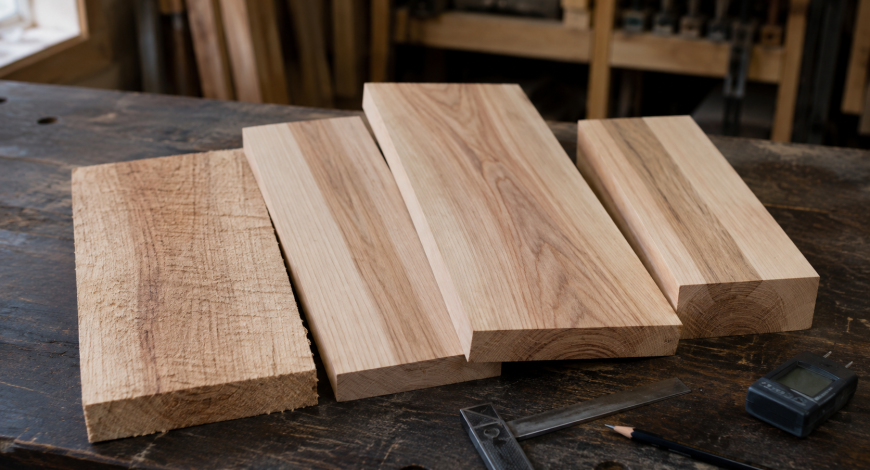
For more than twenty years, customers have asked me whether I offer “Appalachian hickory” and whether it is stronger than regular hickory.
The short answer is simple. Appalachian hickory is not a separate species of tree. It is hickory harvested from the Appalachian region of the eastern United States.
The region produces plenty of excellent hickory, but the Appalachian name does not guarantee a stronger board or a better bokken. Selecting the right individual piece of wood matters far more than the geographic label attached to it.
What Does “Appalachian Hickory” Mean?
The term refers to geographic origin, much like Appalachian oak, cherry, or maple. It does not identify a separate botanical species.
Several hickory species grow within the Appalachian region. Commercial hickory lumber often includes wood from shagbark, shellbark, mockernut, pignut, and bitternut hickory. Some belong to the true-hickory group, while others belong to the pecan-hickory group.
The Appalachian Hardwood Manufacturers association identifies Appalachian hickory simply as Carya spp. The abbreviation “spp.” means multiple species within the Carya genus.
As a result, two boards sold as Appalachian hickory might come from different hickory species and possess different densities, grain structures, and mechanical properties.
Is Appalachian Hickory Stronger?
Hickory itself has an earned reputation for strength, toughness, and shock resistance. It has long been used for axe handles, hammer handles, sporting goods, ladder rungs, and other products subjected to repeated impact.
The United States Forest Service describes shagbark hickory as tough, heavy, hard, resilient, and well suited to applications involving impact and stress.
What is not established is the idea that hickory becomes categorically stronger merely because it grew within the Appalachian region.
Trees are natural materials. Their properties vary according to species, genetics, soil, rainfall, temperature, elevation, competition, age, growth conditions, and location within the trunk. Considerable variation also exists between boards cut from the same tree.
The USDA Forest Products Laboratory explains that mechanical properties vary within every wood species. Published strength figures represent averages from selected specimens tested under controlled conditions. They do not guarantee the performance of every board.
Geography influences how a tree grows, but “grown in Appalachia” is not a mechanical test result.
The Tight-Growth-Ring Myth
One common explanation claims that colder Appalachian winters create slower-growing trees with tighter growth rings, making the wood stronger.
This sounds reasonable, but wood anatomy is more complicated.
Hickory is a ring-porous hardwood. In ring-porous species, wider growth rings sometimes contain a greater proportion of dense latewood. Faster growth is therefore often associated with greater density rather than weaker wood.
Growth-ring width alone does not reliably determine the strength of hickory. A board with narrow rings is not automatically stronger than one with wider rings.
Density, grain continuity, defects, moisture content, and the intended use provide far more useful information.
Is “Impact Grade Hickory” an Official Grade?
Terms such as “impact grade hickory” sometimes appear in descriptions of martial-arts weapons and striking-tool products.
I have not found this term in USDA wood-property classifications or standard hardwood-lumber grading rules. It appears to be a descriptive or proprietary marketing term rather than a recognized species or standardized lumber grade.
A manufacturer might use its own testing and selection process to identify boards suitable for impact. Such selection has value, especially when based on density, grain direction, moisture content, and freedom from defects.
The confusion begins when a company-specific description is treated as a scientifically recognized category applying to all hickory from one region.
What Matters When Selecting Hickory for a Bokken?
The quality of the individual board matters more than whether the lumber dealer attaches the word “Appalachian” to it.
When selecting hickory for a bokken, jo, bo, or other training weapon, I look for:
Straight, continuous grain running through the length of the weapon
Minimal grain runout
Freedom from knots, cracks, checks, decay, and other defects
Appropriate density and weight
Stable moisture content
Proper grain orientation within the finished weapon
Enough material around transitions and high-stress areas
Smooth shaping without abrupt changes that concentrate stress
A straight-grained hickory bokken made from carefully selected lumber is an excellent training weapon regardless of whether the tree grew in Tennessee, Pennsylvania, Ohio, New York, Wisconsin, or another part of hickory’s natural range.
Does Air-Dried Hickory Perform Better Than Kiln-Dried Hickory?
Drying method deserves consideration, but it is another subject often reduced to an overly simple rule.
Poor kiln drying damages lumber through checking, case hardening, honeycombing, or excessive drying temperatures. Poor air drying also causes staining, checking, warping, fungal damage, and uneven moisture.
Properly air-dried and properly kiln-dried hickory both produce excellent woodworking stock. The final moisture content, drying schedule, internal stress, storage conditions, and quality of the individual board matter more than the drying method’s name.
For a finished bokken, dimensional stability is important. Lumber should reach a moisture level appropriate for its working and service environment before final shaping.
What About Tempering Hickory Through Use?
Another claim sometimes associated with hickory weapons is that repeated striking “tempers” the surface, creating a hard exterior while leaving a flexible core.
Repeated contact does compress, dent, and burnish wood fibers. It also contributes to fatigue, crushed fibers, and small fractures. This is not the same process as tempering steel, and I have not found evidence of a unique hickory mechanism producing a reliably hardened exterior through martial-arts practice.
Hickory performs well under impact because of its natural combination of strength, stiffness, toughness, and shock resistance. It does not need a romantic tempering explanation to be an excellent material.
The Honest Answer
Appalachian hickory is real as a regional sourcing description. It is not a unique species, and the name alone does not establish superior mechanical performance.
The Appalachian region has a large hardwood industry, extensive hickory forests, and a long history of producing tool handles and other impact-resistant products. Lumber from the region is often excellent.
The problem is not the term itself. The problem is treating geographic origin as a substitute for inspecting and selecting the wood.
When purchasing a wooden training weapon, ask about the species, grain direction, runout, defects, moisture content, weight, construction, and intended use. Those factors offer more meaningful information than a regional label.
At Blizniak’s Bokken, I select each piece of lumber according to the characteristics of the individual board. I inspect the grain, avoid visible defects, orient the weapon for continuous grain, and shape it according to its intended use.
Good hickory is good hickory. The tree does not become a superhero because it grew near a mountain.
Sources
USDA Forest Products Laboratory, Mechanical Properties of Wood
Appalachian Hardwood Manufacturers, Appalachian Hickory
US Forest Service, Shagbark Hickory Distribution and Characteristics